Project
Labelum
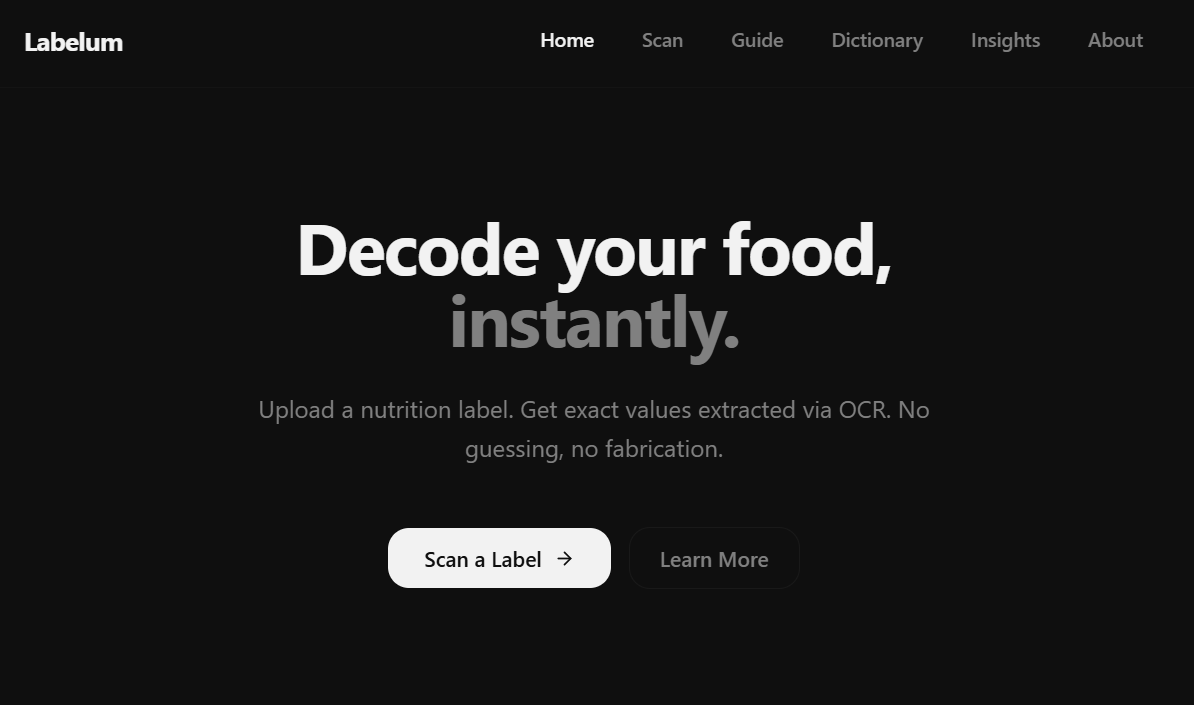
An AI-powered nutrition analysis platform that extracts nutritional information from food labels using OCR and transforms it into understandable nutritional insights.
Overview
What is Labelum?
Labelum is a nutrition analysis application designed to make food labels easier to understand. Instead of requiring users to manually interpret dense nutrition tables, Labelum uses OCR to extract nutritional information and presents it through structured analysis, health scores, key findings, and educational insights.
Motivation
Why I built it
I built Labelum around a simple observation: many consumers rarely take the time to properly understand the information printed on food labels. Even when nutritional information is available, it can be difficult to interpret quickly. I wanted to explore whether taking a picture of a label could become a much simpler way to understand what is actually in a product.
The Problem
The information exists. The interpretation doesn't.
The information consumers need is already present on most food labels, but interpreting it can be difficult. Users may need to understand serving sizes, calories, sugar, protein, fats, sodium, fibre, ingredients, and other nutritional information before deciding whether a product is suitable for them. The challenge becomes even more personal when dietary preferences, allergies, nutritional goals, or individual health considerations are involved. A product that is suitable for one person may not necessarily be suitable for another.
The Solution
Turning raw information into useful insight.
Labelum turns a complex nutrition label into a simplified analysis. Users can provide an image of a nutrition label, after which OCR extracts the relevant information and converts it into structured nutritional data. The application then presents nutritional scores, individual nutrient assessments, key findings, and educational information to help users understand the product more easily.
Process
How it works
Upload
The user provides an image of a food product's nutrition label.
Extract
OCR reads the text on the label and identifies the relevant nutritional information.
Structure
The extracted information is organized into structured nutritional data.
Analyze
The nutritional values are evaluated to produce scores, categories, and useful findings.
Understand
The results are presented in a simpler format so users can quickly understand the product.
Features
What it can do
Nutrition Analysis
Breaks down nutritional values such as protein, carbohydrates, sugar, fat, sodium, fibre, and calories.
Health Score
Provides an overall nutritional score and classification to give users a quick high-level understanding.
Key Findings
Highlights notable characteristics of a product instead of making users interpret every number themselves.
Nutrition Guide
Provides educational information explaining nutrients and how they relate to nutrition and health.
Food Dictionary
Helps users understand ingredients and categories such as additives, preservatives, sweeteners, emulsifiers, and ultra-processed ingredients.
Personalized Analysis
A future direction for Labelum is allowing users to create profiles based on dietary preferences, allergies, nutritional goals, and other individual requirements.
Challenges
What was difficult
Extracting useful nutritional information from food labels that may have different layouts, formats, and ways of presenting values.
Turning raw OCR output into structured information that can be meaningfully analyzed.
Presenting complex nutritional information in a way that remains simple and understandable for everyday users.
Reflection
What I learned
Working with OCR and extracting structured information from real-world images.
Designing interfaces around complex information without overwhelming the user.
Thinking about software as a product that solves a real-world problem rather than simply implementing a technical feature.
What's next